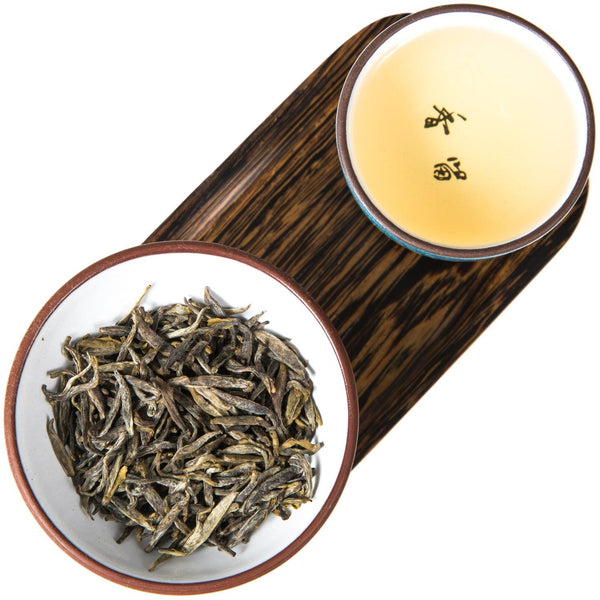
There are 6 main types of tea: White, Green, Yellow, Blue-green (Oolong), Black (Red), and Dark tea (Hei Cha, incl. Pu-erh).
All six types of tea derive from the same plant, Camellia sinensis. What distinguishes them is their level of oxidation and the processing methods applied after harvest. For instance, roasting, steaming, pan-firing and aging.
Below you'll find an explanation of how each type of tea differs. Furthermore, you can learn about their individual characteristics.
The Six Main Types of Tea
White teas

White tea undergoes the least processing among the six different tea types. In addition, the highest grade of white tea consists of the most tender and fresh buds and leaves. Farmers harvest it only during the spring season. The production utilizes the delicate process of withering, curing, and drying. It gives white tea its delicate flavors and a smooth mouthfeel with a subtly fruity or sweet finish.
White teas tend to have less bitterness than other tea types and can be more forgiving of water temperature and infusion times than green teas.
Farmers make the majority of white teas from medium-leaf tea bush varieties that yield silvery-white sprouts and leaves. They are harvested by hand twice a year: in spring (for the higher grades) and in autumn. The withering process of white tea results in an abundance of silvery-white hairs on the dried tea leaves and buds. Authentic white teas such as White Peony are multi-colored like autumn leaves and have a silver-white fuzz that resembles the skin of a ripened peach. Silver Needle, the premier style of white tea, consists of only silvery-white needle-like sprouts without attached leaves.
More delicate white teas brew best at water temperatures around 185ºF (85ºC). It is best to use boiling water for thicker, more mature leaves.
Green teas

Tea enthusiasts love Green Tea for its fresh flavor and health benefits. Farmers predominantly produce them throughout China, Japan, Korea, and Southeast Asia during the spring growing season (March through May).
Tea artisans use various methods of firing freshly harvested leaves to prevent oxidation and preserve the fresh green qualities of the leaf.
Green teas are minimally oxidized. Alongside white tea, they are among the least oxidized of all tea types. The key step that defines green tea is kill-green (Sha Qing – 杀青): applying heat immediately after harvest to halt enzymatic oxidation and lock in the fresh, green character of the leaf. Sha Qing can be applied in several different ways:
- steamed
- pan-fired
- oven-baked
- half-roasted
- half-baked
- hot-air roasted
- sun-dried
When tasting an assortment of green teas, regional nuance, harvest season, leaf style of leaf, and plucking standard become apparent.
Most green teas brew best at water temperatures around 175-185ºF (80-85ºC). However, some Japanese green teas, such as Gyokuro, require a much lower temperature – 150ºF (65ºC).
Yellow tea

Yellow tea is closely related to green tea in its processing, undergoing kill-green (杀青 – Sha Qing) to halt oxidation at a very early stage. What sets it apart is one additional step: Men Huang (闷黄 – 'stuffing the yellow'), in which the warm, slightly moist leaves are wrapped or piled in a closed hot environment. There, it undergoes a slow, gentle transformation that mellows the grassy character of green tea and shifts the leaves to a soft yellow-green color, giving yellow tea its name and its distinctively smooth, mellow flavor. Yellow tea can also be pressed into cakes or bricks, as in the Meng Ding tea brick.
Oolong teas

Oolong teas are semi-oxidized, placing them between green and black tea on the oxidation spectrum. During processing, the leaves go through Zuo Qing (做青 – "making green"): repeated cycles of shaking, which bruises the leaf edges and initiates oxidation, alternating with resting periods that allow the oxidation to deepen. This produces the characteristic "green leaf, red edge" appearance. The degree of oxidation, determined by the number and intensity of Zuo Qing cycles, varies widely between styles – from delicate-tasting Baozhong to those that are almost fully oxidized, like Red Oolong. Today, the main production regions are Fujian, Guangdong, and Taiwan. 
Oolong tea production requires some of the most skillful and sophisticated tea makings. Oolong tea artisans are much like boutique winemakers.
Experts categorize and understand oolong by its region, bush variety, and season of harvest, just like wine.
Most oolong teas brew best at water temperatures of around 195-212ºF (90-100ºC).
Black teas (Red teas)

We say “Black Tea” in the West, or "Hong Cha" ("Red Tea") in Asia.
This tea is popular for afternoon tea thanks to its mellow, sweet flavor.
Unlike green tea processing, which attempts to preserve the green color of fresh tea leaves, black tea processing encourages the tea leaves to change from green to coppery red. We call this change oxidation.
Black (or red) tea has dark leaves and produces a deep-colored liquid.
Most black teas brew best at water temperatures around 195-205ºF (90-95ºC).
Pu-erh teas and Hei Cha

Hei Cha (also known as "dark tea") is a unique variety of fermented tea common in China. Its production process combines fermentation and oxidation, resulting in a type of tea that the rest of the world is only now beginning to appreciate.
Historically, Hei Cha was the primary commodity traded along the ancient Tea-Horse Road (茶马古道), supplying border communities – Tibetan, Mongolian, and others – with vitamins and digestive support that their meat and dairy-heavy diets lacked.
One of Hei cha's most representative teas is indeed Pu-erh. Originating in Yunnan Province of southwestern China, pu-erh tea has an ancient history of more than a thousand years.
There are two different types of Pu-erh: Sheng Pu-erh (the raw or green type) and Shu Pu-erh (the ripened or black type). Farmers produce both Sheng (raw) and Shu (ripe) Pu-erh from sun-dried maocha made from Camellia sinensis var. assamica. Sheng Pu-erh is pressed and then darkens and smooths out slowly through natural aging. Shu Pu-erh undergoes an additional wet-piling (Wo Dui – 渥堆) fermentation step, which yields a dark, mellow liquor even when young; later aging further refines the taste.

Like Champagne or other regionally specific foods and beverages, Pu-erh is a geographically indicated product. Under China’s national standard, only tea made from sun-dried large-leaf tea grown and processed within a defined area of Yunnan can be sold as Pu-erh. Similar large-leaf teas are grown in neighboring countries such as Laos, Myanmar, Thailand, and Vietnam, but those fall outside the protected Pu-erh designation.
Pu-erh remains an integral part of the food culture throughout Southeast Asia. Traditional Chinese Medicine has used it for centuries to promote digestion and aid the breakdown of heavy foods.
Most pu-erh teas brew best at water temperatures around 212ºF (100ºC).