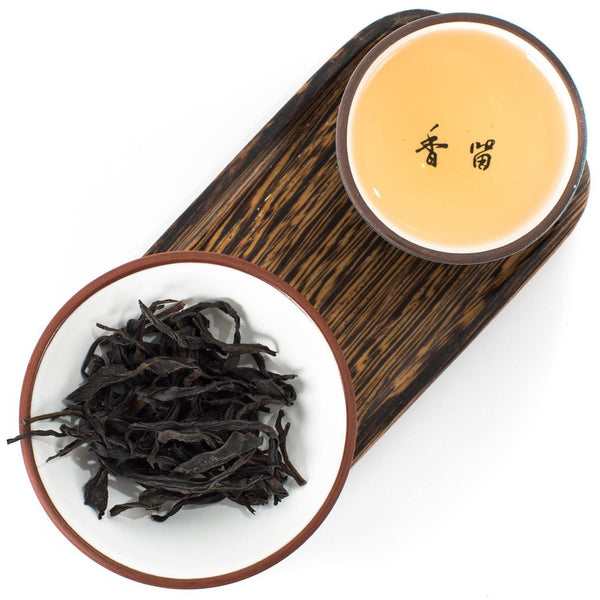
"Champagne of teas", "the perfume of teas" – just a few of the nicknames given to one of China's most celebrated teas: Dancong Oolong. Emerging as a distinct tea type during the Ming dynasty, Oolong quickly established itself as one of the most aromatic and complex teas among China's six categories.
In this blog post, we'll unveil the mystery behind one of the most captivating aromas in the world of tea. We'll explore the factors that influence the formation of Oolong tea's taste and aroma and analyze them from both nature's and science's points of view. We're talking specifically about Dancong Oolong, as it's the one type of Oolong tea with the most abundant variety of aroma profiles. However, the factors that influence the formation of the aroma and taste of Dancong Oolong apply to virtually any type of loose-leaf oolong tea. Ready for it? Let's begin!
The Chemistry Behind Oolong Tea Taste and Aroma
Before elaborating on Oolong tea taste and aroma, let's first mention that different factors can influence the formation of tea taste and smell in any type of tea; some of them are naturally present in the tea plant, some of them form throughout the process of turning fresh tea leaves into finished tea, and others are external factors of the tea plant's growing environment. We'll get into the details of each group shortly, but first, let's provide a quick chemical overview.
The proportion of aromatic substances in fresh tea leaves is indeed tiny. Only 0.005% to 0.03% of the inner compounds of tea leaves are aromatic substances, yet there are over 80 types of them. They are a crucial factor affecting the quality of tea. When it comes to aromatic compounds in the finished tea, the six tea types are not created equal. For example, there are over 260 types of aromatic substances found in green tea. Black tea (hong cha) has over 400 types, while Dancong Oolong tea has a whopping 500 types.
So far, over 700 tea aroma compounds exist naturally or form throughout the process of turning fresh tea into a finished tea.
According to spectral analysis, the key aromatic compounds in tea include alcohols, aldehydes, ketones, esters, lactones, phenols, and their derivatives, as well as sulfur- and nitrogen-containing compounds.
A Matter of Taste
Dancong Oolong tea is known for its distinct fragrance and flavor. It comes in a wide variety of aromas, captivating tea enthusiasts worldwide. The Dancong Oolong tea taste and especially aroma are so intense and pervasive that some tea lovers question whether they are natural or artificially enhanced.
Truth is, several factors, both internal and external, influence the development of Dancong Oolong tea's taste and aroma. First, there's the inherent scent of the tea leaves themselves. Then there's the influence of the tea tree's surrounding environment – the soil, climate, and overall ecology where it grows. The third component is the aroma developed during the tea's production and roasting. Lastly, aged Oolong teas develop a unique, mature fragrance over time. Each element combines to create the signature aroma of Dancong Oolong tea, making each sip a delightful experience.

The Root of Aroma: Tea Leaf's Natural Scent
Let's start with the aroma that is already present in the tea leaves. In their fresh state, tea leaves already contain a plethora of scents nestled inside the plants' cells, including aromatic compounds such as linalool and dihydro-linalool, to name a few. The specific mix and concentration of these elements shape the distinct Oolong tea taste and aroma profile. Some of the fresh and floral notes we sense in tea have already been programmed by the very presence of these substances inside the tea leaf; however, to get the Oolong tea taste and aroma to develop to their fullest potential, the tea needs to go through some processing, which takes us to the next impacting factor.
From Leaf to Fragrance: The Art of Processing Oolong Tea
While the leaf naturally contains a certain amount of aromatic substances, these alone wouldn't be enough to produce the intense, almost intoxicating Dancong aroma we know so well. The character of Dan Cong Oolong is shaped by a precise and demanding production process, one that is more complex than that of virtually any other Chinese tea type.
Sun withering (晒青 – Shai Qing): Freshly picked leaves are spread under sunlight to reduce moisture content and begin the aromatic transformation. This step also softens the leaves in preparation for what follows.
Indoor cooling (晾青 – Liang Qing): Leaves are moved indoors to cool and stabilize. Moisture continues to evaporate evenly, and the first aromatic changes begin to take hold.
Making the green (做青 – Zuo Qing): This is the heart of oolong production and the step most responsible for Dan Cong's signature aroma. The tea master alternates between tossing and bruising the leaves (碰青 – Peng Qing) and allowing them to rest. The bruising ruptures the cell walls at the leaf edges, releasing polyphenols and initiating enzymatic oxidation. As oxidation progresses at the bruised margins, aromatic compounds form and evolve, building the floral, fruity, and complex notes Dan Cong is celebrated for. This cycle is repeated multiple times over many hours, with the tea master reading the leaves and adjusting at each stage. The degree of oxidation, controlled entirely through Zuo Qing, is what distinguishes different oolong styles from one another.
Killing green (殺青 – Sha Qing): Once the desired level of oxidation is reached, heat is applied to halt enzymatic activity and lock in the aromatic profile developed during Zuo Qing.
Rolling (揉捻 – Rou Nian): The leaves are rolled to release their internal juices, which coat the leaf surface and concentrate flavor compounds for brewing.
Drying and roasting (烘焙 – Hong Bei): Initial drying removes remaining moisture. Roasting (traditionally done with charcoal) is where sugars and amino acids undergo Maillard reactions, producing toasted, nutty, and caramel-like depth. For some Dan Cong varieties, roasting is repeated periodically – a processing step that further develops the tea's depth over time.

Terroir's Touch: Climate and Soil in Oolong Tea Taste and Aroma
The environment also plays a defining role in shaping Oolong tea's taste and aroma. Things like soil composition, rainfall, exposure, altitude, and tree age all leave their mark on each tea's unique flavor profile.
Let's take Dancong as an example. The yellow soil common in the Chaozhou region is rich in organic matter and a variety of minerals and trace elements. The tea plant absorbs them and transfers their metabolites to the buds and leaves, creating a rich and layered flavor profile. In turn, dark red soil and paddy soil, with their excellent moisture and warmth retention, are slightly acidic with a pH of 5.5-6.5. That makes them ideal for tea tree cultivation. These soils are common in lower mountainous regions and areas where fields have been converted to tea plantations. Their characteristics contribute to the robust growth of tea trees, ensuring a rich harvest of quality leaves.
The tea tree age is directly related to the soil and how the plant interacts with it. Young tea trees have shallower roots. That makes them susceptible to changes in rainfall, sunlight, and temperature. They can't reach into the deeper layers of the soil. That often results in a lighter, fainter brew that doesn't hold up well against multiple steepings. However, as tea trees mature, their roots extend deeper and spread out, becoming more resilient to environmental stresses such as drought or extreme temperatures. This stability ensures a consistent growth of new shoots. Mature tea trees draw up deep-seated nutrients, giving their leaves a distinctive taste. The tea made from these mature leaves is richly aromatic, with a lingering sweetness in every cup.
Altitude also affects the overall flavor profile of Oolong tea. Aside from the specific soil composition in the higher parts of the tea mountains, other specifics like day/night temperature variations, increased UV radiation, and the year-round presence of clouds/ fog influence the growth and metabolism cycle of the tea tree, altering the leaves' composition and ultimately creating the unique Shan Yun (山韵 – "Mountain Rhyme") – the lingering depth and complexity that is the hallmark of high-quality Phoenix Dan Cong.

Aged to Perfection: The Impact of Storage on Oolong Aroma
We're used to associating aging and storage mostly with Dark Tea (Hei Cha) and the ubiquitous Pu-erh tea. You might be surprised to learn that in Fujian, Taiwan, and Chaozhou, among others, people have long cherished the tradition of aging Oolong tea. Properly stored aged Oolong tea undergoes a natural transformation over the years. With proper storage, the polyphenols inside the tea leaves transform, creating unique flavor profiles and a distinctive mouthfeel that sets it apart from Pu'er and dark teas. Through expert processing and repeated charcoal roasting under proper storage conditions, Oolong tea’s aroma deepens over time. The initial surface notes give way to a richer bouquet, yielding a tea soup that gains complexity with age. As the years pass, the color of the tea darkens to a bright, clear red, and the taste becomes increasingly smooth.