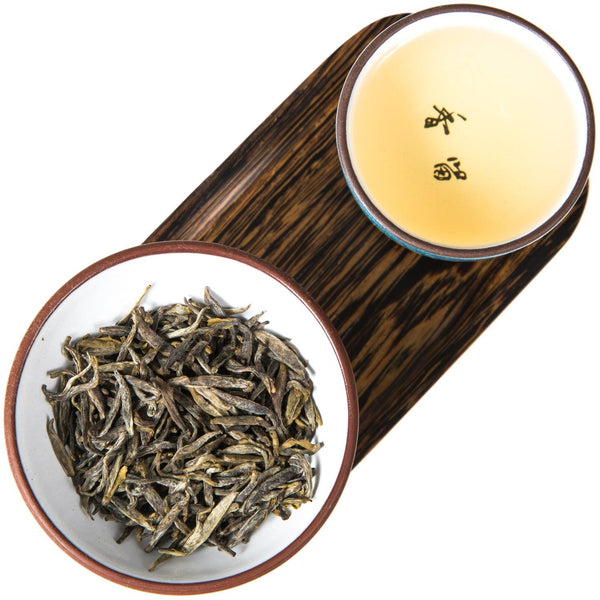
Yellow tea is a rare variety of loose-leaf tea, with the least amount of production and with very few regions producing it. For the hundreds of named green teas in China, only a small handful of yellow teas remain in regular production today. The best-known are Junshan Yinzhen, Meng Ding Huang Ya, and Huo Shan Huang Ya, along with a few others such as Huang Xiao Cha and Huang Da Cha. Being by far the rarest in China’s six tea categories, yellow tea, however, is an essential part of China’s long-lived tea tradition and is frequently featured on China’s ‘Ten Famous Teas’ list.
What Is Yellow Tea?
Yellow tea (黄茶 – Huang Cha) is one of China's six classical tea categories. Yellow tea is very close to Green tea in processing, but with an extra "yellowing" step. The leaves are first pan-fired to fix them (杀青 – Sha Qing), much like green tea. Unlike many green teas, they’re not dried completely at this stage, so they retain some warmth and moisture. After that, the tea maker carries out Men Huang (闷黄) – wrapping or heaping the warm, slightly damp leaves in a closed environment. In this gentle, humid heat, the leaves slowly change in color and flavor, losing some of green tea’s grassy edge, becoming more mellow and shifting towards a soft yellow-green color.

A primary aim of making yellow tea is to remove the grassy characteristic of green tea, while still preserving its fresh qualities.
Yellow tea has a smoother palate than that of green tea, and many believe that it is also more gentle on the stomach.
Yellow tea production is very time-consuming and difficult. Unfortunately, as demand for green tea has dramatically increased and it is much easier to produce, many have abandoned the production of yellow tea in favor of green tea. The knowledge of the yellow tea-making process is almost forgotten. Today, only a limited number of skilled tea masters in places like Hunan, Sichuan, Anhui, and Zhejiang still produce authentic yellow teas.