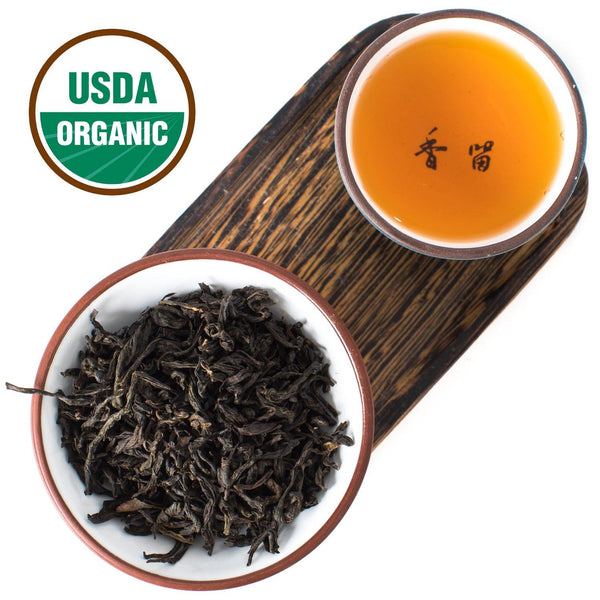
Chinese black tea – Hong Cha (红茶 – Red Tea) – is one of the world's most produced and widely consumed teas, but in China it has a different name, a different history, and a fundamentally different character from the black teas most Westerners know. The name Hong Cha means "Red Tea" – named for the warm, coppery color of the brewed liquor, not the dark dry leaf. It is an entirely separate tradition from Indian Assam or Ceylon, with a broader range of styles, subtler flavors, and no need for milk or sugar.
In the West, we refer to it as "Black Tea" while in Asia, people call it "Hong Cha" (红茶 – "Red Tea"). Black tea is well-known as an afternoon tea for its mellow and sweet flavor.
Black tea is believed to have first been developed in Tongmu, Wuyi Mountains in northern Fujian, China, during the late Ming or early Qing dynasty.
Before the mid-17th century, most tea consumed in China was Green (unoxidized) tea (though dark teas already existed in some regions).
Nowadays, Red tea is one of the most popular and widely produced teas in the world. However, it wasn't always this way.

The History Of Hong Cha In A Nutshell
In fact, up until the 19th century, black tea wasn't widespread at all. One of the earliest and most historically important black teas was a modern-time favorite – Lapsang Souchong (Zhen Shan Xiao Zhong) from Tongmu. Read more on Chinese black tea history here.
For decades, even centuries, people barely consumed black tea in China. At the time, farmers produced hong cha almost exclusively for export. Chinese black tea wasn't an equal within the Chinese tea market until quite recently — it began to rise domestically in the late 20th century and surged in 2005.
In 2005, a tea technologist from Tongmu, Jiang Yuanxun (Wuyi Zheng Shan Tang Tea Company), developed a new type of black tea, known as Jin Jun Mei. What made this tea special was that it was made solely from the tea buds. A pound of this tea was sold abroad for a few thousand US dollars. This event brought the collective mindset within China to see Chinese black tea as an item of appreciation. Thus, a new era of hong cha emerged.
How Is Black Tea Made?
Green tea processing attempts to preserve the green color of fresh tea leaves. On the other hand, black tea processing encourages the tea leaves to oxidize and change color from green to coppery red. We call this oxidation.
Being fully oxidized, black (or red) tea has dark leaves. It produces a deep-colored liquid, as well as tender, yet profound characteristics.
During processing, Chinese black tea goes through the following steps:
Black tea at peak oxidation is undeniably sweet and mellow, differing it from all the other tea types.

The Most Famous Chinese Black Teas
Lapsang Souchong Black Tea
One of the earliest - if not the earliest - black tea in existence was Lapsang Souchong. This smoky black tea originated in the Wuyi Mountains of Fujian province, in the area of Tong Mu Guan. Nowadays, this area is a national treasure.
Tongmu Guan is a protected national nature reserve – access is restricted and regulated, with visitors requiring a permit to enter. This protection is part of what has preserved the area's wild tea trees and centuries-old production methods. This area is the birthplace of black tea, and farmers there still produce Zheng Shan Xiao Zhong. However, a large amount of Lapsang Souchong doesn't come from this area, and some tea companies falsely market it as Lapsang Souchong.
Traditional Lapsang Souchong Black Tea is made in a unique smokehouse, using the smoke from pine tree branches. Because Lapsang Souchong grows at high altitudes in a slightly northern region of China, farmers harvest this tea last. Lapsang harvest dates extend into late May (Chinese tea harvest season begins as early as late February).
Dian Hong Black Tea
Dian Hong Black Tea is a group of teas from Yunnan province (the same province as pu-erh tea) and is currently one of the most popular teas in China. Tea enthusiasts love it for its thick, robust taste with a gracious floral aftertaste. The tea itself is relatively new, emerging in the late 1930s.
"Golden Eyebrows" Jin Jun Mei Black Tea
Jin Jun Mei (金骏眉 – "Golden Eyebrows") holds a unique place in Chinese tea history. Created in 2005 in Tongmu Village by tea master Jiang Yuanxun, it was the tea that reignited domestic Chinese interest in hong cha after centuries of near-indifference. Made entirely from hand-picked spring buds, with an enormous quantity of buds required per 500g of finished tea, Jin Jun Mei was expensive from the start, but its taste is unlike anything in the existing black tea canon: golden-yellow liquor, a sweet and refreshing entry, an intensely floral fragrance, and a long finish that lingers. A pound of this tea was sold abroad for thousands of dollars, piquing public interest, and the resulting wave of appreciation transformed Chinese black tea production.
Today, most "Jin Jun Mei" on the market is made outside Tongmu Village, from different materials, and at a fraction of the price. Genuine Tongmu Jin Jun Mei remains rare. Ours comes from Tongmu Village, the original source.
Keemun Black Tea
Keemun black tea, or Qi Hong, is one of the first black teas we recommend to people getting into the sublime and at times mysterious world of hong cha. It has an intense yet delightful fragrance of flower fields and ripe fruit, incomparable to that of other Chinese black teas.