Teaware


Moon Rabbit is a mystical figure from Chinese culture. If you look up during the full moon, you'll see him with a mortar, pounding elixir of life. This 200ml Yixing Teapot, shaped like a Dragon Egg, will make a lovely addition to your Gongfu tea set. Duan Ni Yixing clay (Zi Sha) has an excellent sand structure that softens bitterness and astringency, allowing your tea to shine.


This Yun Si Fang teapot blends the aesthetics of round and square forms with a delicate, elegant design. It's a masterful combination of symmetry and fluidity – where the roundness meets the structure of the square. This 100ml wood-fired teapot is made from DuanNi ZiSha from Ben Shan – the original Yixing clay mines. DuanNi clay has an excellent sand structure, which softens the harsh notes in tea by reducing bitterness and astringency.


Ce Ba (侧把) – side-handle teapot, is a reminder of the long conversation between Chinese and Japanese tea traditions. This 100ml wood-fired teapot is made from coarse-grained, aged Yixing DuanNi clay from Ben Shan – the original deposit, valued for its excellent sand structure, which softens the harsh notes in tea, helping the tea really show itself. The surface shows a warm, subdued sheen which will develop a fine patina over time.


This 110ml Rong Tian (容天) is a classic Yixing Teapot. Its name means "Accommodating Heaven," and the shape reflects that spirit. The body is round and full, with a low center of gravity that gives it a solid, grounded presence in the hand. It's a pot that feels generous in shape and character. This teapot is made from Zhao Zhuang Zhu Ni – a particularly fine kind of Yixing clay. This clay is prized for its ability to age and build character over time.


Xi Shi teapot from the finest ZhuNi Yixing clay is a piece of timeless elegance. Reminiscent of the legendary beauty of ancient China, this classical shape resembles Xi Shi's round face, the spout looks like a beautiful mouth, and the handle resembles her elegant hair bun. The size of 80ml makes it ideal for enjoying tea solo or with someone special, perfectly fitting into a pair of small Gong Fu Cha teacups. This Xi Shi teapot is designed to enhance the tea experience while adding a touch of elegance to your collection.


Qin Quan is one of the classic Yixing shapes, inspired by the bronze weights used during the Qin dynasty. This 180ml Yixing teapot has a fast pour and is made from ZiNi – slightly porous Yixing purple clay that gently softens rough edges in the tea while keeping the aroma clear and focused. The outside of the teapot is finished with HeiNi – another Yixing clay that fires to a deep black tone. This Qin Quan also features the classic Taotie (饕餮) mask motif.


Shui Ping is a timeless design piece. This 110ml teapot is made of 20-year-old purple clay, Zi Ni. Aging the clay is a lengthy process that enhances the properties of the famous purple clay. Aging the clay helps the material mature: the particles break down more evenly, the moisture distribution stabilizes, and the clay becomes more homogeneous. It accounts for a warmer, more vibrant color and a better overall look and feel of the finished product.


Li Xing form is considered one of the most classic and time-honored shapes in Yixing pot making. This 110ml teapot is crafted from ZiNi clay from Huang Long Mountain (黄龙山) – the very core area of Yixing clay production. What gives this teapot its unusual black appearance is not paint or glaze but the result of a reduction firing process. It is finished with Sa Jin (紫砂洒金) – a traditional decorative technique that dots the surface with touches of gold, creating a contrast against the dark clay.


This 140ml teapot is made of purple clay from the delta of the Yangtze River, aka Yixing clay or Zi Sha. Zi Ni clay is unique for its porosity and high iron content, which can affect tea taste by reducing astringency and bitterness. The shape is the classical Xi Shi (西施). Xi Shi was a famous beauty of ancient China. The shape resembles her full, round face, the spout looks like a mouth, gentle and graceful, and the handle resembles her elegant hair bun.


This 110ml handmade Chaozhou teapot is crafted in a classical Dragon Egg shape, caroled by Qing Dynasty poet Wu Dingme. Chaozhou clay, with its excellent heat-retaining properties, is high in iron oxide but less porous than Yixing ZiSha (primarily due to higher firing temperature) and is good at preserving tea's bright, floral notes. This teapot is a perfect match for your floral Dan Cong Oolongs.


This is a 150ml handmade Jianshui Zitao teapot. Density is what makes Jianshui teaware the most versatile of the four famous clays. You can brew Sheng Pu-erh in it one afternoon and Dan Cong Oolong the next. The two-tone color you see on this pot (warm red-brown on the outside, deep black on the inside) comes from reduction firing. This teapot is perfect for three drinkers, generous for two, and light enough for a solo session.


Tokoname teapots date back over 800 years ago to the Kamakura Period. The clay inside reacts with tannins in the tea to decrease bitterness. Carefully crafted in Aichi prefecture, this 330ml teapot is well thought through and has a mesh lining filter inside.


What can be more enticing than watching rising steam, listening to crackling charcoal, boiling water, and a Chaozhou clay kettle clacking lid? The Chaozhou charcoal stove and clay kettle are a must-have if you are serious about Gong Fu Cha. It will transform the entire tea experience by taking it to the next level. Many argue that water boiled on the open fire in a clay kettle is so much better than the one boiled in a stainless steel electric kettle.


This graceful 140ml turquoise Gaiwan depicts white cranes — a symbol of longevity and peace in Chinese culture. When using a small tea infuser like a gaiwan, tea is brewed in concentrated quantities. This allows for full extraction of the tea's qualities. The glazed ceramic gaiwan is perfect for any type of tea.


A gaiwan, used for infusing tea leaves, allows the tea drinker to smell the aroma and observe the tea leaves unfurling. This 120ml Yixing Gaiwan is made of Zi Ni – ZiSha clay. Zi Ni clay possesses excellent porosity and heat-retention properties that can remove harsher notes, improving the taste of tea.


Exquisite 130ml Mutton Fat Jade Porcelain Gaiwan. Smooth to the touch and slightly translucent, this matte material will enhance your tea experience. It resembles a precious form of nephrite highly valued in Chinese culture. The handwritten calligraphy reads "一心问茶" (Yī Xīn Wèn Chá) — "Approach Tea With a Focused Heart." This phrase resonates with Zen philosophy and the practice of Gong Fu Cha.


This 130ml Heart Sutra Gaiwan, crafted from unglazed Dehua clay, features the intricate Heart Sutra etched on its exterior. Its design showcases a beautiful contrast between the interior and exterior colors, enhancing both the visual and tea-drinking experience.


This 130ml Silver-Lined Porcelain Gaiwan features a serene landscape with scholars in cobalt blue. The silver interior ensures even heating and softens water, enhancing the tea's sweet notes. The porcelain exterior protects your fingers from heat, making it both beautiful and practical for any tea session.


This 170ml Iron-Gilded Aged Clay Houhin features an antique bronze finish and retro elegance. Made from aged Dehua clay with a gilded iron glaze, it enhances tea's sweetness and aroma. The high-temperature reduction firing process gives it a distinctive and textured appearance.


This 120ml Arita-Yaki Porcelain Shiboridashi Teapot is especially well-suited for brewing Japanese green teas. The blue splashes on the surface are done in the Fukizumi style (吹墨), where the color is applied by flicking the glaze with the fingers, creating an organic pattern that feels spontaneous. No two pieces turn out the same!


This 120ml Silver-Lined Shiboridashi Teapot is especially well-suited for brewing Japanese green teas. The vessel, made of famous Arita-Yaki Porcelain, is hand-carved using the Tobikanna technique (飛鉋) – a method of decorating the surface with rhythmic, fine markings. After carving, a layer of silver is brushed onto the surface, and the piece is fired again. Silver is known to affect the taste of water, making it feel softer and bringing out the tea's natural sweetness. Each piece is carved by hand, so no two are exactly alike.

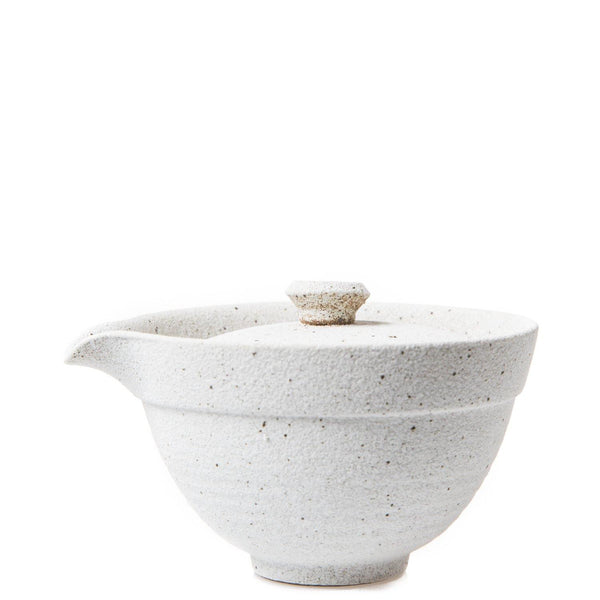
Shiboridashi is a traditional Japanese brewing vessel. Its name translates to "to squeeze out", describing how the lid helps to extract every last drop of tea. Shiboridashi is used to brew teas like Gyokuro or Sencha. In Japanese culture, the white color symbolizes purity and relates to the spiritual world.


This tea set by A Jie includes the "Rough Diamond" Gaiwan and Teacup, both crafted using high-iron Dehua clay and a traditional wood-firing process. The rugged and faceted designs complement each other beautifully, and the smaller size of the gaiwan makes it perfect for solo tea sessions with your most precious teas. Each piece is unique, reflecting the natural elements of fire and clay, and brings out the tea’s natural sweetness.


In the set: Yixing Teapot (Zi Sha: Zi Ni), and two sets of matching Yixing Clay Zi Ni Aroma Teacups. Compared to glass, porcelain, glazed teapots, or even other ZiSha clays, ZiNi clay enhances the flavors and aromas of tea by reducing bitterness and astringency.
About Teaware [+]
Gong Fu Cha (工夫茶) is a practice of making tea with skill, patience, and attention – 工夫 (Gong Fu) meaning the time and effort invested in mastering a craft. The teaware is not incidental to that practice. The material of the vessel, its size, its porosity, and its heat retention all shape what ends up in the cup. Choosing the right teaware for a particular tea is part of the craft itself.
Our teaware spans the major traditions of Chinese and Japanese tea practice – from Chaozhou clay stove and Yixing ZiSha teapots to Japanese Kyusu and Chawan. Browse by category, or read on for guidance on pairing teaware with tea type.
What Is Gong Fu Cha?
Gong Fu Cha is the Chinese practice of brewing tea in small, concentrated quantities using a high leaf-to-water ratio and short, repeated infusions. The same leaves are steeped multiple times. Each infusion reveals something different about the tea.
What Is a Gong Fu Tea Set?
A complete Gong Fu tea set typically includes a small teapot or gaiwan, a Cha Hai (茶海 – Fairness Pitcher), and teacups. A full setup may also include a tea tray (Cha Pan – 茶盘), tea tools (Cha Dao – 茶道), and a tea pet (茶宠 – Cha Chong). Having a complete set is not essential – many practitioners start with just a gaiwan, Cha Hai, and a few cups.
What Is a Tea Pet?
A tea pet (茶宠 – Cha Chong) is a small clay figurine that lives on the tea tray and receives the leftover tea during the session – rinse water, first steep, the last drops from the Cha Hai. Over time, an unglazed clay or porous stone tea pet absorbs the tea's oils and develops its own patina.
Gong Fu Tea Cups
In Chinese, the small drinking cups used in Gong Fu Cha are called Pin Ming Bei (品茗杯 – Tasting Cups). In the West, "Gong Fu teacup" is more widely used. Standard Gong Fu cups range from 30–90ml – small enough to concentrate aroma and encourage multiple short steepings.
Aroma Cups
Aroma cups (闻香杯 – Wen Xiang Bei) come in sets of two: a tall, slender cup and a short, wide tasting cup. Tea is poured into the tall aroma cup, which is then covered with the tasting cup and flipped. The tea moves to the tasting cup, and the aroma cup – still warm – is lifted and inhaled. This practice is most common with aromatic Taiwanese oolongs, though it works with any fragrant tea.
Yixing ZiSha (宜兴紫砂) – The Most Famous Chinese Clay
Yixing clay (ZiSha – 紫砂) comes from Yixing county in Jiangsu province. Its breathable micro-structure and steady heat retention soften some of the harsher edges in the tea, producing a rounder, smoother cup. Because unglazed Yixing clay is porous, it gradually absorbs trace amounts of tea over time – seasoning the vessel and allowing a subtle interaction between clay and liquor that deepens with each session. For this reason, many practitioners keep Yixing teapots dedicated to a single tea type or family.
The main ZiSha clay types:
- Zi Ni (紫泥 – Purple Clay): The most classic and versatile. Breathable, with balanced heat retention. Suited to pu-erh, aged teas, and oolongs.
- Zhu Ni (朱泥 – Red Clay): Fine-grained and less porous than Zi Ni, characteristic red-to-vermilion color. Favored for high-fragrance teas.
- Duan Ni (段泥 – Layered Clay): Stronger sand structure, more absorbent than Zi Ni, softens bitterness and astringency. Color ranges from golden beige to light yellow.
- Lu Ni (绿泥 – Green Clay): Named for the pale green color of the raw ore. After firing, it becomes pale yellow to beige depending on the temperature. A rare clay with excellent breathability.
Unglazed Yixing teaware should never be cleaned with detergent – water only.
Jianzhan (建盏 – Tenmoku)
Jianzhan (建盏) is Chinese black porcelain from Jianyang, Fujian, originating in the Song dynasty (960–1279 AD). The high iron oxide content in the glaze gives Jianzhan its distinctive deep black to iridescent blue-black tones, and has a practical effect on the tea: when hot water contacts the iron-rich glaze, iron ions are released that soften the water, neutralize tannins, and produce a noticeably smoother, sweeter mouthfeel. Jianzhan is particularly well-suited to pu-erh, dark oolongs, and black tea. For reference comparison, pair your Jianzhan cup with a neutral porcelain or glass vessel and taste side by side.
Teapots and Gaiwans
There are two primary brewing vessels in Gong Fu Cha: the teapot and the gaiwan.
A gaiwan (盖碗 – lidded bowl) consists of a bowl, lid, and (sometimes) saucer. Both gaiwan and Chinese Gong Fu teapots are small – typically 80–200ml – and made from clay, porcelain, or glass.
Choosing Teaware by Tea Type
White Tea Young white tea is delicate. Use thin-walled porcelain or glass – neutral vessels that won't overpower subtle florals. Yixing clay is not recommended for young whites; it can mask the tea's delicacy. Aged white tea, however, benefits from thick-walled vessels and handles Yixing well.
Green Tea and Yellow Tea Thin porcelain or glass works best. Green tea is temperature-sensitive and benefits from quick pouring – choose a teapot with a fast-flowing spout.
Light Oolong Tightly rolled lightly oxidized oolongs (Taiwanese high mountain, Anxi Tie Guan Yin) need room to expand. Use a tall, round teapot or gaiwan. Porcelain or glass preferred; porous clay is workable but less ideal.
Wuyi Rock Tea and Dan Cong Oolong Dark, roasted, strip-leaf oolongs suit flat, short teapots with thick walls. Porous clay – particularly Yixing Zhu Ni and Chaozhou Hong Ni – is the traditional choice: the clay rounds out robust flavors and accumulates the aromatic oils over time.
Black Tea (红茶 – Hong Cha) Chinese black tea handles high temperatures well. Thick-walled teapots and Yixing clay suit most styles. Exception: highly smoky teas like Lapsang Souchong are best brewed in porcelain or glass so the smoke doesn't permanently season the clay.
Raw Pu-erh (生普洱 – Sheng), Ripe Pu-erh (熟普洱 – Shou), Hei Cha (黑茶) Porous, heat-retaining clay teapots that absorb excessive bitterness and astringency and integrate the earthy, woody character of the tea.
Japanese Tea
Matcha (抹茶) requires a chawan (茶碗 – tea bowl), a chasen (茶筅 – bamboo whisk), a chashaku (茶杓 – bamboo scoop), and a matcha sifter. The chawan must be wide enough for the whisk to move freely.
Kyusu (急須) A traditional Japanese side-handle teapot made from clay. The built-in mesh filter holds back fine Japanese leaves. Used for sencha, genmaicha, hojicha, and most everyday Japanese green teas.
Shiboridashi (絞り出し) or Houhin (宝瓶) Similar to a gaiwan in form but with a built-in spout filter. The lid acts as a strainer during pouring. Ideal for low-temperature, umami-rich teas like gyokuro and premium sencha.
Tetsubin (鉄瓶) A traditional Japanese cast-iron kettle, used for boiling and holding water. The modern version – the Tetsu-Kyusu – is enamel-coated inside and can be used for brewing. Do not place on a stove.