Bug-bitten Tea

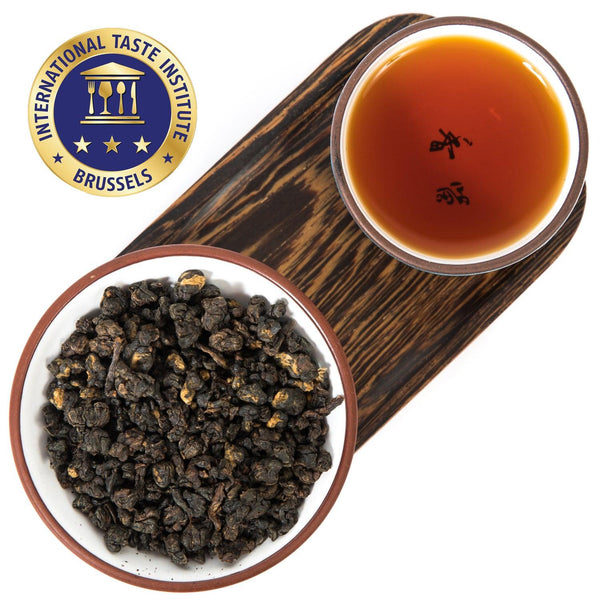
• Taste: honey-sweet • Aroma: honey & ripe fruits • Mouthfeel: thick & silky


• Taste: honey, ginger, chrysanthemum • Aroma: champagne & foliage • Mouthfeel: creamy & tingly
About Oolong Tea [+]
Oolong tea (乌龙茶 – Wulong Cha, aka "Black Dragon Tea") sits between green and black tea – partially oxidized, endlessly varied, and widely considered the most complex category in Chinese tea. The technical term is Qing Cha (青茶 – Blue-Green Tea). In practice, no two oolongs taste alike: a lightly oxidized, floral Taiwanese high mountain oolong and a deeply roasted Wuyi rock tea are both oolong, separated by everything from cultivar and terroir to the skill of the roaster.
Our collection spans the full range – Chinese and Taiwanese loose-leaf oolong teas, carefully selected across styles and regions.
What Does Oolong Tea Taste Like?
It depends entirely on the style. Lightly oxidized oolongs are refreshing, floral, and sometimes creamy, like our Ali Shan Jin Xuan oolong, which carries a natural milky sweetness from the cultivar itself (金萱), not from additives. Darker oxidized oolongs are fruity and roasted, with notes of caramel, stone fruit, and nuts. Wuyi rock oolongs (岩茶 – Yan Cha) carry an unmistakable mineral backbone – what the Chinese call Yan Yun (岩韵 – "rock rhyme"). Dan Cong oolongs (单丛) are sharp and intensely fragrant, with each cultivar mimicking a different aroma: gardenia, orchid, honey, pomelo. Lightly oxidized oolongs are also exceptional as cold brew.
Types of Oolong Tea in This Collection
Dan Cong (单丛 – Phoenix Single Bush) Dan Cong grows semi-wildly in the Phoenix Mountains (凤凰山) of Guangdong, China. High-quality Dan Cong comes from old tea bushes (老丛 – Lao Cong) – decades-old, often semi-wild, with deep root systems. Each Dan Cong cultivar mimics a distinct natural aroma. Among the most searched: Ya Shi Xiang (鸭屎香), also known as Duck Shit Oolong, a name that does the opposite of what it sounds like. It's one of our bestselling teas for a reason – gardenia-fragrant, honey-sweet, and unlike anything else. Mi Lan Xiang (蜜兰香 – Honey Orchid) is the other essential – layered, floral, with a long finish.
Yancha – Wuyi Rock Oolong (岩茶). Yancha grows in the rocky Wuyi Mountains (武夷山) of Fujian province, from mineral-rich soil that gives these teas their signature Yan Yun. Da Hong Pao (大红袍 – Big Red Robe) is the most famous of its sub-types. Our selection also includes Rou Gui (肉桂 – Cinnamon Rock Oolong) and Shi Ru (石乳 – Stone Milk). These are some of the most prized oolongs in the world – deep, complex, and long on the finish.
Taiwanese High Mountain Oolong (高山茶). Taiwan produces some of the most prized high-mountain oolong teas in the world, often grown at elevations of 800m and above, where cooler temperatures slow leaf growth and concentrate flavor. Our Taiwanese range includes such teas as Da Yu Ling (大禹嶺), Li Shan (梨山 – Pear Mountain), Ali Shan Jin Xuan (阿里山金萱), Dong Ding (冻顶 – Frozen Summit), and Bao Zhong (包種) from Wenshan. High mountain teas have a more complex flavor with less bitterness and a characteristic creamier mouthfeel.
Tie Guan Yin (铁观音 – Iron Goddess of Mercy) is one of the most technically demanding oolongs to produce, due to its intricate tossing technique (摇青 – yaoqing). The result is an incomparable floral aroma. Our Anxi Tie Guan Yin comes from Southern Fujian, China – the original producing region.
GABA Oolong is processed in a low-oxygen environment that converts L-theanine to GABA (Gamma-Aminobutyric Acid). A GABA tea must contain at least 150mg of GABA per 100g of dry leaf. Known for a notably calming effect alongside tea's natural L-theanine and caffeine.
Oolong Tea vs Green Tea vs Black Tea
Oolong is partially oxidized. It is more oxidized than green tea (which undergoes no oxidation), but less oxidized than black tea (fully oxidized). A lightly oxidized oolong can resemble green tea: pale, fresh, floral. A heavily oxidized, roasted oolong can resemble black tea: dark, bold, and malty. The distinction lies in what happens during Zuo Qing (做青) – the alternating shaking and resting that bruises the leaf edges, activating partial oxidation while leaving the leaf's center green.
How to Brew Oolong Tea
Most oolong teas brew best at 195–212°F (90–100°C). For Gong Fu Cha (工夫茶), use a gaiwan or a small teapot, usually of 80–200ml (the standard size is 120ml). Rolled oolongs, like Dong Ding or Anxi Tie Guan Yin, will benefit from a round vessel that gives room for the leaves to expand. Strip-leaf oolongs, like Dan Cong and Yancha, are less demanding of space. Oolong is also one of the best teas for multiple infusions – a good-quality oolong will yield 6–10+ steeps, each revealing something new.
Oolong Tea Caffeine Content
Though it is not straightforward, Oolong tea usually has mid-range caffeine content. Oolong leaves are larger and more mature at harvest, which contributes to lower caffeine than young-bud teas. The combination of caffeine and L-theanine (naturally present in all tea) produces focused, calm energy without the jitters associated with coffee.
Oolong Tea Processing
- Withering (Wei Diao – 萎凋) – sun and/or shade exposure removes excess moisture.
- Bruising / Making Green (Zuo Qing – 做青 / Yao Qing – 摇青) – alternating shaking and resting bruises leaf edges, activating partial oxidation.
- Kill Green (Sha Qing – 杀青) – high heat halts oxidation at the desired level.
- Rolling (Rou Nian – 揉捻) – shapes the leaf and activates juices; produces either ball-rolled or strip-leaf form depending on the style.
- Roasting (Hong Bei – 烘焙) – the final transformation; charcoal roasting in multiple cycles determines depth, color, and shelf life.
Aged Oolong
Properly roasted oolongs can be aged. Stored airtight, away from light, for three years or more, they develop deeper, more complex flavors. Our 10-Year Aged Lao Cha Oolong from Taiwan is the proof.