




A young monk once asked the wise tea master Lao Cha
– Sifu, why is Tie Guan Yin such a famous tea? Why does everyone love it?
– It's because it takes a real tea master to produce this tea. The leaves have to go through so many steps: tossing, roasting, rolling, etc. But once it's ready – oh, how good it tastes! Try this one – it's so light and floral. It tastes like late spring itself.
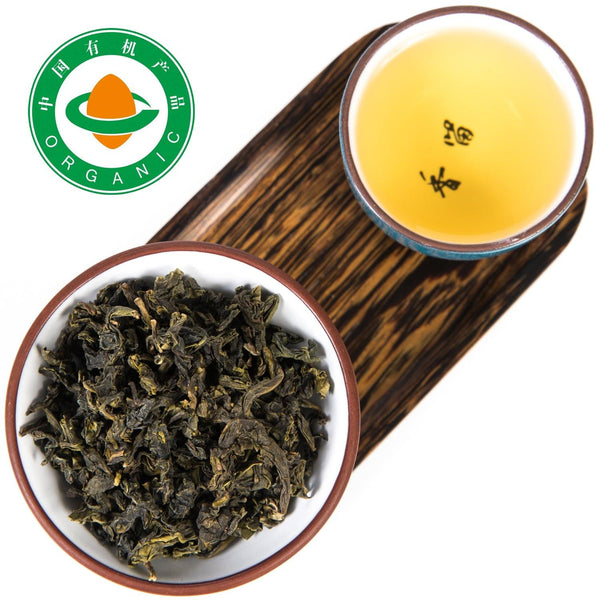
Tie Guan Yin (铁观音) – the "Iron Goddess of Mercy", is the undisputed crown jewel of Southern Fujian Oolong teas. While the ancient, traditional version of this tea was heavily roasted, the tea you are looking at represents the modern Qing Xiang (清香 – "Clear Fragrance") style – a lighter, floral brew that lacks the heavy, roasted notes of its ancestors.
Crafting Tie Guan Yin is incredibly labor-intensive. It begins with a very specific plucking standard: rather than picking tender young buds, farmers wait for the shoot to reach the Kai Mian (开面 – "Open Face") stage, harvesting thick, mature leaves that can survive the intense shaping process.
The most critical step is the heavy tossing (摇青 – Yao Qing), which slowly bruises the leaves to induce oxidation. This exhausting cycle of tossing and resting is the secret to forming the tea's Guan Yin Yun (观音韵) – a signature, lingering orchid fragrance and sweet, nectar-like mouthfeel that earned it a permanent spot among China's "Ten Great Famous Teas."
This exceptional Anxi Tie Guan Yin, crafted by tea master Zhou Jin Fa, is sweet, mellow, and creamy. Its long-lasting finish will easily carry you through multiple infusions, revealing delicate vanilla and pine nut notes.

Master Zhou Jin Fa rolling Tie Guan Yin
There are many legends surrounding this tea's name. They all trace back to Guanyin (观音), the Bodhisattva of Compassion. One of such legends tells of a poor, devoted tea farmer in Anxi's Songyan village. For decades, he served a daily cup of tea to the Guan Yin Bodhisattva. One night, Bodhisattva. appeared in his dream and guided the man to a secluded cave. The next morning, the farmer followed the path he had seen in the dream and discovered a tea bush, fragrant, unlike any other. Overjoyed, he brought the cuttings home, planted them in an iron cauldron, and named it "Tie Guan Yin" to honor her gift.
Brewing guidelines:
-
 195℉ / 90℃
 -
 1 g per 70-100 ml
 3-5 min
 -
 1 g per 20 ml5 sec + 5 sec for each subsequent infusion