


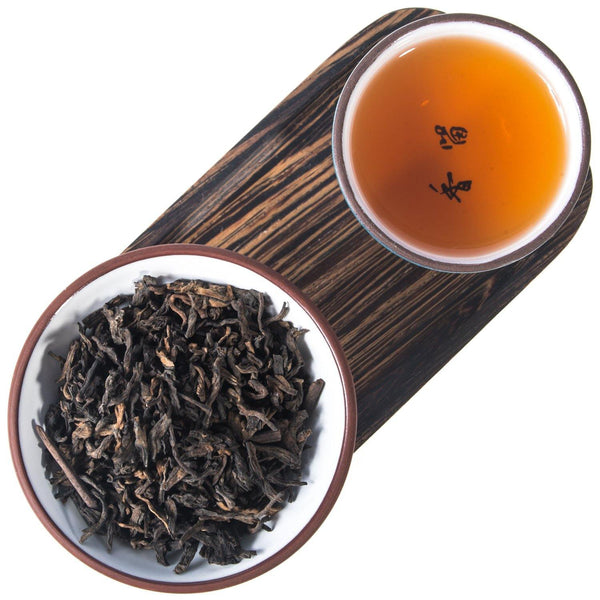


Long ago, the wise tea master Lao Cha was on a pilgrimage through the mountainous ranges of Guangxi province, China, when he stumbled upon a tired farmer:
— Sifu, do you have something that is comforting, like rice porridge, yet sweet, and at the same time uplifting, like coffee, that will help me tackle all this work?
— Of course, my friend! Let me share a basket of Liu Bao with you.
Liu Bao is often called the sister tea of Shou Pu-erh. The resemblance is real, but the family tree is not direct. Liu Bao tea comes from Guangxi province and dates back to the 17th century, while the local tea culture is likely older still. In Guangxi, farmers developed post-fermentation techniques of their own, independent of the pu-erh industry to the west in Yunnan.
Shou Pu-erh and Liu Bao are closer to siblings than parent and child.
Traditional, farmhouse-style Liu Bao follows Kill Green (杀青 – Sha Qing) and Rolling (揉捻 – Rou Nian). Then comes Dui Men (堆闷) – which means "pile and smother." While the leaf is still moist from rolling, it's piled and left to build heat for roughly 10 to 15 hours, undergoing a light fermentation before it's dried (晒干 – Shai Gan) and packed into bamboo baskets to age slowly over years. Dui Men is gentler and shorter than the deep, water-added wet-piling used in modern factory production. It preserves more of the leaf's original character.
Liu Bao became especially popular with Chinese laborers who emigrated to work in Malaysian tin mines in the late Qing and early twentieth century. The tea was valued for its warming, damp-clearing qualities in the region's hot, humid conditions. Large quantities were exported there as a result, and old stocks of Liu Bao are still found across Malaysia today. The tea also remains popular in the humid climates of Guangdong and Hong Kong.
In the mid-20th century, state tea factories in Guangdong and Guangxi aimed to satisfy the overseas demand for dark, mellow tea that didn't require decades to mature. Guangxi's tea industry adopted a cold-water wet-piling process for Liu Bao around 1958. This modern method closely resembles the Wo Dui (渥堆) fermentation that Yunnan developed for ripe pu-erh in the 1970s. The two processes share a common technical lineage, but neither was simply copied from the other.
Compared to Ripe Pu-erh, this tea has a lighter body and a more nuanced taste. Liu Bao is sweet and soft, earthy, with deep notes of red dates, tobacco, and betel nut.
Brewing guidelines:
-
 212℉ / 100℃
 -
 1g per 70-100ml
 3-5 min
 -
 1g per 20ml10 sec + 5 sec for each subsequent infusion